Let's start with what matters: You don't learn to drive using your cell phone.. Driving is about motor coordination, reading real traffic, and reacting to the unexpected—things that can only be acquired behind the wheel, with an instructor beside you and dual controls. What a cell phone does, and does very well, is the other half of the process: the theoretical part. Study the legislation, memorize traffic signs, practice with mock tests, and arrive at the DMV exam knowing the format of the questions.
Having made that distinction, the app becomes a useful tool instead of a false promise. In this guide you will see how the driver's license process works in Brazil in the correct order, what type of app helps at each stage, an important warning about foreign apps that are useless here, and a study method that fits into twenty minutes a day.
What cell phones can solve and what they can't solve.
- Solve: Study the legislation, memorize signs and signals, practice with simulations, review defensive driving and first aid, monitor the progress of the process, and save the document in digital format.
- It doesn't solve the problem: Practical lessons, the practical test, vehicle spatial awareness, clutch and accelerator coordination, the habit of checking the rearview mirror, and reaction to unexpected events on the road.
No mobile phone simulator counts as classroom hours, and none of them are accepted by the Department of Motor Vehicles (Detran) in place of training with a certified instructor. Anyone who promises otherwise is selling what they cannot deliver.
Driver's license in Brazil, in order
1. Requirements and opening of the process
You must be at least 18 years old, be able to read and write, and present an identity document and CPF (Brazilian taxpayer identification number). The process is initiated at the Detran (Department of Motor Vehicles) in your state, either in person or through digital channels, and you will receive a number that will accompany you until the end.
2. Aptitude tests
Before any classes, there's a physical and mental fitness exam, conducted by a certified doctor, and a psychological evaluation. This is the stage that fails more people than you might imagine, almost always due to uncorrected vision problems—it's worth getting an eye exam beforehand if you suspect you need one.
3. Theoretical course
The content is the same throughout the country and is divided into five areas: traffic legislation, defensive driving, First aid, environment and citizenship It is basic mechanics concepts. The test focuses precisely on these five areas—and this is where the app truly shines.
4. Theoretical test
There are 30 questions, and passing requires getting at least 70% correct, meaning 21 questions. The test is administered by the Detran (Department of Motor Vehicles), nowadays almost always on a computer, and the result is given immediately. Failed? You can retake it after the deadline set by your Detran, without starting the process from scratch.
5. Practical classes and practical exam
The practical part is done in a suitable vehicle, with certified instructor, ...and culminates in the practical test administered by the Department of Motor Vehicles (Detran), with an examiner. No part of this phase takes place via cell phone. The training rules have been undergoing changes recently — before signing up for anything, confirm on your state's Detran website what is currently in effect, how many classes are required, and where they can be taken.
6. Driver's License
Once you pass the driving test, you receive a Provisional Driving Permit, valid for one year. At the end of this period, it becomes your permanent driver's license if you have not committed any serious or very serious infractions, nor are you a repeat offender of medium-level infractions. In practice, it's a year of monitored behavior—and it's worth taking seriously.
Beware of foreign apps.
A large portion of the "driving test" apps that appear in searches were made for another country. The most common ones are American, geared towards the DMV exam — the traffic department of the United States states. Some of them advertise this in their description, mentioning the American driver's license, and yet they still appear in lists in Portuguese.
They're not useful here, and it's not just a language issue. The legislation changes, the signs change, the right-of-way rules change, the speed limits change, and the exam format itself changes. Studying with material like that is worse than not studying at all, because you end up confidently memorizing the wrong rules.
How to identify it in ten seconds: Open the app's listing in the app store and look for mentions of DMV, US states, "learner's permit," or traffic signs in English. If the screenshots show signs with a yellow diamond shape written in English, it's for another country. What's relevant here mentions... Detran, CTB or Driver's License Right in the description.
The types of apps that really help.
Practice test with Brazilian question bank.
This is the most useful category. Good practice tests include questions separated by the five areas of the course, correct them instantly, and—the detail that makes all the difference— They explain why the incorrect alternative is incorrect.. A practice test that only shows the grade at the end teaches little. Prefer one that records your statistics by topic, so you can see where you're losing points.
Official app of the Department of Motor Vehicles (Detran) of your state.
Several Detrans (Brazilian state traffic departments) maintain their own app, which allows for process tracking, scheduling, checking points, fines, and, in some cases, an official practice test. It's the most reliable source available because it's the same institution that administers the test. Search for the name of your state's agency and check if the developer is the state government.
Digital Traffic Wallet
It's the official app of the national traffic system, where you'll find digital versions of your driver's license and vehicle registration, as well as traffic violation notifications. It's not for studying, but it's where your driver's license will reside once it's issued—and it's free.
Signage study
Flashcard apps featuring Brazilian road signs—regulatory, warning, and informational—solve the most frequently appearing topic on the exam through repetition. They work better in short, daily sessions than in a marathon review the night before.
The Brazilian Traffic Code in text
The Brazilian Traffic Code (CTB) is Law 9.503 of 1997, and it is public. There are apps that provide the text with search and favorites features, useful for checking the exact wording when a question seems ambiguous. A warning: laws change, and outdated apps can be misleading. When in doubt, check the official text published by the government.
Driving simulator — what is it?
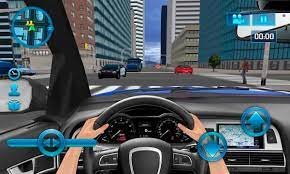
Simulation games help familiarize you with gear shifting logic, dashboard reading, and spatial awareness. It's entertainment with some educational value, and nothing more. It doesn't count as a lesson, doesn't replace practice, and isn't accepted anywhere in the process. Treat it as a warm-up, not training.
A study method that works.
- Take a full practice test right from the start., Before studying, the grade will be bad, and that's the intention: it shows where you're losing points.
- Attack the weakest area first. It's almost always legislation or signage that are the most frequently disregarded.
- Study in short, daily blocks. Twenty minutes a day yields far more than three hours on Sunday. Spaced repetition is what makes signs and articles of law stick.
- Read the explanation for any question you get wrong., and redo only the mistakes two days later.
- In the last week, do full timed practice tests., to get used to the format and the time frame.
- The day before, just check the signage. And go to bed early. Studying late at night isn't worth it.
How to choose the right app without wasting time
- Check out the country. You need to mention Detran, CTB, or CNH. If you say DMV, it's from another place.
- See if the answer explains it. A practice test without explanation trains luck, not knowledge.
- Check the date of the last update. Traffic laws change; a question bank that has been stagnant for years teaches outdated rules.
- Consistent permissions. A practice test app doesn't need contacts, SMS, a microphone, or location services.
- Understand the billing process. Many apps offer a few free features and charge for the rest through a subscription. Check the price on the store's listing beforehand, and remember that uninstalling doesn't cancel the subscription—cancellation is done through the store.
- Be wary of "guaranteed approval". No one can guarantee passing a public service exam.
What falls into each of the five areas
Knowing the names of the subject areas is of little help; knowing what they cover changes the whole study process. Here's a map of the content, in order of its typical weight on the exam.
Traffic legislation
This is the area that appears most frequently. It covers road classifications, traffic rules and right-of-way, overtaking, speed limits when there is no signage, mandatory driver and vehicle documents, the nature of traffic violations and their corresponding penalties. It also includes required equipment and rules for transporting children. If you only have time for one area, this is it.
Defensive driving
The second most important area. It deals with following distance, driving in rain and fog, aquaplaning, fatigue, distraction, blind spots, night driving, seatbelt use, and behavior in unforeseen circumstances. It's the most "thinking-oriented" area: many issues are resolved by considering what reduces risk, not by memorizing.
First aid
Few questions, but easy to answer. The core principle is always the same: mark the location, protect the scene, call for help, and... Do not move the victim. Without absolute necessity. Whoever understands this principle gets almost everything that comes up here right.
Environment and citizenship
Air and noise pollution, proper disposal of oil, tires and batteries, maintenance that reduces emissions, respect for pedestrians, cyclists and people with disabilities. It is the area with the most common sense issues — and for that very reason the one that the fewest people study and the most people make mistakes due to carelessness.
Basic mechanics concepts
The smallest of them all. Function of the car's systems, warning signs, dashboard lights, tire pressure, oil and water levels, pre-trip check. It doesn't require mechanic knowledge: it requires knowing what to do when a light comes on.
The signs that are most confusing
Signage is what yields the most low-cost points, because the answer lies in the shape and color before it's in the design. The Brazilian system is organized into three families:
- Regulation — Circular signs with a white background and a red border. They impose an obligation or prohibition, and disobeying is an infraction. The two exceptions to the format are precisely the most important: the stop sign, which is octagonal, and the yield sign, which is a triangle with the point facing downwards.
- Warning — A yellow diamond with a black border and symbol. They warn of a road condition ahead: curve, speed bump, school, intersection. In roadwork areas, the same diamond appears in orange.
- Indication Rectangular signs in various colors. They provide information on distance, destination, services, and tourist attractions. They are not binding.
The pairs that most often trip up candidates are always the same: no parking versus no stopping and parking, which are distinguished by the number of lines inside the circle; no entry versus mandatory passage; and maximum speed limit versus regulated speed limit on a specific stretch. It's worth creating cards only with these groups and reviewing them every day.
How much does it really cost — and how does the app charge?
Two different accounts come into play in this story, and it's best not to mix them up.
The first one is the process itself, And it has nothing to do with digital processes: Detran (Brazilian DMV) fees, physical and mental aptitude exams, psychological evaluation, course, and practical lessons. The amounts vary from state to state and are adjusted from time to time, so the only honest place to check is the table published by the Detran of your state. Be wary of any advertisement that promises a fixed number valid for the entire country.
The second one is the study app, And here are four models:
- Free with ads. You pay with attention and data. It works well if the advertising doesn't interrupt the simulation mid-way.
- Free sample with subscription. It unlocks a handful of questions and charges a monthly fee for the full database. It's the most common model.
- One-time purchase. Less frequent, but it's usually cheaper for those who will use it for two or three months.
- Official and free. The official Detran app, when available, is free of charge — and it's the most reliable source there is.
Three practical tips regarding pricing: the price that counts is the one that appears on the store's listing, not the one in the advertisement; Uninstalling the app does not cancel the subscription., The cancellation is processed through your store account; and the trial period that requires a card will automatically become a charge if you don't cancel before the deadline.
The day of the exam, in order
- Confirm location and time. Check your local DMV's official channel the day before. The change of office and address will take place.
- Bring official photo identification., The original document, within its validity period, is required. Copies are usually not accepted.
- Arrive with plenty of time to spare. There is an identity check and, in many places, biometric registration before being seated.
- Put your cell phone away. Having electronic devices in hand during the application process can lead to elimination — leave them in the car or switched off in your bag, as instructed by the facility.
- Read the entire question before looking at the answer choices. A large portion of the errors stem from wording that includes "except" and "not," which often goes unnoticed.
- Write down any questions and come back later. Since the test is computer-based in most DMV offices, it's possible to review it before finalizing.
- Check the result, Keep the receipt, which usually comes out immediately. If you fail, write down the areas where you got wrong while it's still fresh in your mind.
Other questions about the test and the apps
Do I need internet access to use a practice test app?
It depends. Many stores the question bank on the device and work offline; others load everything from the server. If you study using public transport, check this detail before subscribing.
How many questions a day are enough?
Twenty to thirty questions a day, with a reading explanation for each error, yield more results than two hundred once a week. What helps people memorize signs and articles of law is spaced repetition, not concentrated volume.
Does the practice test have the same questions as the actual exam?
No. Nobody has access to the official database. What a good practice test reproduces is the format, the style of the questions, and the content covered—and that's already quite a lot.
Does an app with outdated questions cause problems?
Yes, it can be a problem. Traffic rules change, and a bank that's been stagnant for years teaches you things that are no longer valid. Check the date of the last update on the store's listing before choosing.
Is there an audio version available for those who have difficulty reading?
Some apps read the instructions aloud, and both Android and iPhone have a built-in screen reader that works on top of any app. Regarding special test application requirements, the Department of Motor Vehicles (Detran) in your state is the one that provides that information.
Read also
- Speed Camera Alerts on Cell Phones: What the Law Allows and What it Prohibits
- Free Radar Alert: How the Alert Works and Where It Fails
- GPS Without Internet: 5 Apps with Offline Maps to Download Beforehand
- View Your City by Satellite: The Apps and Why the Image Isn't Live
- Free Offline GPS: How to Download the Map and Navigate without Data
Common questions
Is it possible to get a driver's license without driving school?
The training rules have undergone recent changes, and what applies depends on what is in effect in your state. What remains unchanged: the medical and psychological exams, the written test, and the... practical test The responsibility for practical training remains with the Department of Motor Vehicles (Detran), and it must be conducted by a certified instructor. Confirm this on your state's Detran website before hiring any instructor.
How many questions are on the theory test?
There are 30 questions, and you need to get at least 70% correct — 21 of them — to pass. The result is usually given immediately, since the test is administered on a computer in most Detrans (Brazilian traffic departments).
Does a practice test app replace a theoretical course?
No. The course is a formal step in the process, and the app is a study tool. In practice, the two complement each other: the course provides the content, and the practice test shows whether you've learned it.
I failed the theory test. Do I have to start all over again?
No. You retake the test after the deadline set by your DMV, keeping the process open. Use the break to address exactly the areas where you made mistakes.
Does an American app help at all?
Only if you're driving in the United States. For the Brazilian exam, it's a hindrance: the legislation, signs, and right-of-way rules are different, and you end up memorizing the wrong answer.
Can I drive with only a learner's permit?
Yes, it is valid for one year and serves as a driver's license during that period. At the end of the term, it becomes the permanent driver's license if there are no serious or very serious infractions, nor repeated medium-level infractions.
Conclusion
Your cell phone is a great ally in the theoretical part of the driver's license exam: with practice tests from Brazilian question banks, daily study of traffic signs, and the official app from your state's Department of Motor Vehicles (Detran), you can arrive at the test well-prepared spending little or nothing. This part, yes, fits in the palm of your hand.
The other half doesn't fit, and it's good not to be fooled by that: practice is learned behind the wheel, with a certified instructor, and the practical test is administered by the DMV. No app, however realistic it may seem, can replace the first time you have to do a real parallel parking maneuver — and that's precisely why training requires an instructor by your side.