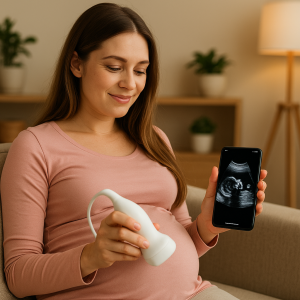
Late period, tender breasts, morning sickness: your mind races and you crave an immediate solution. But there's a technical limitation that no app can overcome— The cell phone does not detect pregnancy.. There is no pregnancy test inside a phone, simulated or otherwise.
The reason is simple to understand. Pregnancy is confirmed by the presence of hCG, HBr, a hormone produced after the embryo implants in the uterus. It appears in urine and blood, and that's what home pregnancy tests and laboratory exams look for. An app doesn't have access to either of those. What it has is the data you enter: dates, symptoms, temperature. With that, it calculates probability—and probability is not a result.
That said, cycling apps are genuinely useful right now, and this guide explains exactly how: they tell you when to test, They help you interpret your own body and organize the information that the consultation will require.
Advantages of tracking your menstrual cycle via mobile phone.
Knowing the right date to test
Testing too early is the main cause of false negatives. An app that knows your cycle indicates when hCG tends to be detectable, avoiding the expense of a test that will give a useless result.
To see one's own pattern.
Cycles of 26, 31, 35 days — each body is different. After a few months of tracking, the "delay" gains context: for many people, what seemed like a delay was normal variation.
Symptom diary with dates
Nausea, fatigue, cramps, mood swings. Noted on the day they occurred, they became a timeline that helps the doctor. From memory, this information is easily lost.
Birth control reminder
Forgetting to take your pill is one of the most common causes of unplanned pregnancy. A daily alarm solves this.
Organized information for reference.
The date of the last menstrual period, average cycle length, and symptoms displayed on a single screen saves time and avoids the "I think it was at the beginning of the month" scenario.
How does the test that truly answers work?
Pharmacy test (urine)
Detects hCG in urine. Works best with the first urine of the morning, which is more concentrated. Start testing on the first day of your missed period—before that, the chance of a false negative is high. Two lines, even if one is faint, is a positive result. A single line is a negative result. or The test was done too early; if menstruation doesn't come, repeat it after a few days.
Blood test (Beta hCG)
It is the most sensitive and reliable. It detects the hormone before the urine test and, in quantitative format, provides the value — allowing for monitoring of its progression. It is performed in a laboratory, with a doctor's order, and is available in the public healthcare system.
Ultrasound
It's not used to detect pregnancy in the early stages, but rather to confirm where the pregnancy is and how it's progressing, after the hCG test has already indicated it. It's a different step.
Why "cell phone pregnancy test" doesn't exist.
From time to time, apps appear that promise to interpret a photo from a pharmacy pregnancy test or give a verdict based on a questionnaire. It's worth understanding the limitations of each one.
Photo from the test: Image reading depends on lighting, the test model, the time elapsed since application, and the camera. An evaporation line—which appears when the test dries and doesn't mean anything—can be read as positive. And the test manufacturer itself advises reading within the time interval indicated in the instructions, not later.
Symptom questionnaire: Almost all early signs of pregnancy are the same as those of premenstrual tension. Nausea, breast tenderness, fatigue, and mood swings occur in both cases. A questionnaire that returns "80% chance" is transforming anxiety into numbers, not making a diagnosis.
Neither is a criminal scam — many warn in the fine print that it's entertainment. The problem is the decision a person makes believing in the outcome.
Worthwhile features in a cycling app
- 🔔 Prediction of the next menstruation and fertile window: This is an estimate based on your history, not a certainty.
- 📊 Cycle duration chart: It shows whether they are regular or not, information that the gynecologist asks for.
- 📝 Symptom-free record: The more open fields, the better.
- 🔒 Lock with password or biometrics and option to erase everything: Reproductive health data is sensitive; you need to be able to remove it from the app.
- 📤 Export to PDF: to take to the appointment.
- 📴 Offline functionality: It avoids relying on a server and reduces the amount of data leaving the device.
Common Care or Mistakes
- ❌ Treating prediction as diagnosis: No app confirms or denies pregnancy.
- ⏳ Testing too early: This generates a false negative and more anxiety. Expect a delay.
- 📅 Incorrect registration: If the dates are inaccurate, all predictions will be inaccurate.
- 🔇 Ignoring warning signs: Severe abdominal pain, unusual bleeding, or fainting require immediate medical attention, with or without suspicion of pregnancy.
- 🔐 Not looking at the privacy policy: Ask yourself if you would be comfortable with that leaked history. If the answer is no, choose another app.
Interesting Alternatives
- 🧪 Pharmacy test: Cheap, fast, and reliable when done at the right time.
- 🏥 Beta hCG in the public healthcare system: The primary healthcare unit requests it, and the result is the most reliable available.
- 🧭 Consultation with a gynecologist or primary care nurse: In addition to confirming, it provides guidance on what to do next in any given scenario.
- 📓 Note on paper: If privacy concerns outweigh convenience, a notebook will do the trick.
- ☎️ Public health guidance services: Getting your questions answered by a professional is free and worth more than any quiz.
How the app calculates the forecast — and why it gets it wrong.
Understanding the underlying calculations prevents both disappointment and overconfidence. There are no sensors involved: the app uses arithmetic based on what you've typed.
- At first, he kicks. Without historical data, almost every application assumes a standard cycle duration, inherited from textbooks. If your cycle doesn't have this duration, the initial predictions will be wrong—and that's not a defect, it's a lack of data.
- Then, he uses his average. With several recorded cycles, the forecast begins to rely on its own historical data. The more months recorded, the closer the estimate gets to its actual pattern.
- Ovulation is estimated, not observed. The app doesn't see anything happening in your body. It positions the fertile window by calculation, counting backward from your next predicted period—that is, one prediction on top of another prediction.
- Incomplete registration poisons the average. A forgotten month causes the app to interpret two cycles as one, and the average jumps. Correcting the date later usually reorganizes everything.
- Temperature and other signals are entered manually. When the app accepts these records, you are the one who measures and enters the data, using the technique and consistency that the method requires.
The correct way to read the screen, therefore, is: “"Based on what I've recorded, it's likely that"”. This is not a measurement of what is happening today. An app that presents the estimate as a certainty, with percentages and everything, is transforming simple arithmetic into something resembling an exam.
Why the fertile window in the app doesn't work as a contraceptive method.
This is the most important aspect of the subject, and the least discussed. The colored window on the screen is an estimate calculated from averages—and ovulation, even in those with regular cycles, can occur outside of the expected timeframe due to any change in routine, stress, or health that month.
There is a big difference between an app's calendar and real, studied fertility awareness methods: the latter require training with a professional, daily observation, and specific decision-making rules., And even then, they have failure rates that need to be known by those who adopt them. None of that fits on a colorful screen filled with three taps.
In practice, this means three things:
- use the app to avoid Pregnancy, relying solely on screen color, is not a method — it's a gamble;
- use the app to to try Getting pregnant is legitimate, and that's what he does best: it helps to regulate your period and understand your own pattern;
- Choosing a contraceptive method requires discussion with a healthcare professional, who knows your medical history and the available options. No app has enough information to make that decision.
What usually messes up the cycle schedule?
When the prediction is way off, the first reaction is to blame the app. Most of the time, the explanation lies in what happened in life that month. Cycle changes are common and have known triggers:
- Intense stress and sleep deprivation — exam period, bereavement, job change, night shift.
- Travel involving a time zone change., which disrupts the biological clock for a few days.
- Illness, even if temporary, and fever.
- significant weight change, up or down, and major changes in diet.
- Sudden increase in training, especially during high-intensity activity.
- Starting, changing, or stopping hormonal treatment. — the body takes time to show the new pattern.
- Breast-feeding and the period following childbirth.
- Life stages in which the cycle naturally changes its behavior, such as the first few years after menarche.
Noting these circumstances in the observation field, in the month they occurred, is what transforms "the app was wrong" into useful information. And honesty is key: Irregular menstrual cycles without explanation, irregular bleeding, severe pain, or prolonged absence of menstruation are matters for a healthcare professional., That's not for the app. The registration is specifically for arriving there with dates, not impressions.
More questions about cycle tracking apps and pregnancy tests
How many months do I need to record for the forecast to be accurate?
There's no magic number, but the logic is simple: the more complete cycles you record, the more the average describes you and the less it depends on the generic pattern the app assumed at the beginning. A few months already significantly change the quality of the estimate.
Can the app tell if I'm pregnant before my period is even late?
No. It can indicate that the predicted period has passed, which is calendar arithmetic. What actually answers is the hormone detected in the urine test or blood test—before that, any percentage on the screen is a formatted guess.
I've been recording everything wrong for months. Is it possible to fix it?
Yes, it works. Almost all of them allow you to edit or delete old cycles, and the average recalculates itself. If you don't remember the dates for sure, the best approach is to delete the questionable period instead of filling it in from memory.
Do I really need to create an account with an email address?
Some apps work locally, without registration. This is the least exposed option, with a practical consequence: without an account there is no backup, so losing your phone means losing your history. Exporting occasionally solves the problem.
Is it possible to lock the app so that no one else can open it?
Many offer a password or biometric authentication, in addition to screen locking on your phone. It's worth activating: it's the same level of care you take with your bank's app, and the content here is just as personal.
Can I bring my app history to the appointment?
It can and should be done. Dates of last periods, average duration, and symptoms exported onto a single page answer, in seconds, questions that would take half the consultation time if you were to remember them from memory.
Read also
- Portable Ultrasound on Your Cell Phone: How it Works and Who Can Use It
- Diabetes on Your Cell Phone: 8 Apps for Blood Glucose, Insulin, and Reports
- Boy or Girl? What Do Guessing Apps Really Do?
- Mobile Glucose Apps: Recording, Graphs, and Sensor Readings
- Blood Pressure Apps: What They Record and What They Don't Measure
Frequently Asked Questions (FAQ)
No. Pregnancy is detected by the hCG hormone in urine or blood. No cell phone sensor can access that information.
They are unreliable: lighting, test model, and elapsed time can alter the reading, and evaporation lines are misleading. Read the test with your own eyes, within the time indicated in the instructions.
Starting on the first day of your missed period, use your first morning urine. If the test is negative and your period doesn't come, repeat the test a few days later or take a blood test.
They serve to record, and the record is precisely what helps to show the irregularity to the doctor. The predictions, in these cases, are much less precise — and this is a real limitation, not a flaw in the app.
Very similar. Nausea, breast tenderness, fatigue, and mood swings occur in both cases. That's why symptoms don't confirm anything—only hCG confirms.
Conclusion
The wait for that answer is agonizing, and that's precisely why the subject attracts so many easy promises. What works is less glamorous and much more effective: use a cycle tracking app to... knowing when to test and for record what your body is doing, Take the home pregnancy test at the right time and confirm with a Beta hCG test.
And, regardless of the result, schedule the appointment. If it's positive, prenatal care starts early, and that makes a difference. If it's negative and your period still hasn't come, there's also something to investigate. In both scenarios, the test results are the answer—the app just helps you get there organized.