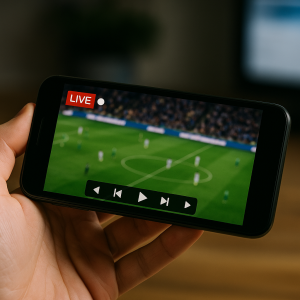
Want to watch your favorite channels on your phone? You can, and it's free in most cases — as long as you understand the rule that governs everything in this matter: Television broadcasting rights are purchased, and purchased by country.. That's why an app works perfectly in the United States and shows a blank screen here, and that's why "the most used app in the world" might not work for you.
This guide separates existing services into three categories: free, ad-supported services, paid services that rely on subscriptions, and those that simply don't operate in your region. It also explains why the solution many people try—using a VPN to pretend they're in another country—isn't the shortcut it seems.
Advantages
Watch wherever you are.
Within your hiring area, you can watch it on the bus, in line, or during your work break, without needing a fixed television.
Varied and multilingual curriculum
International news, culture, documentary and entertainment channels, many with audio and subtitles in multiple languages.
It works on various devices.
Mobile phones, tablets, browsers, and connected TVs, with mirroring via Chromecast or AirPlay.
Quality that adapts to the connection.
The player measures the available speed and adjusts the resolution, preferring to continue running rather than freeze.
Real free layer
Several services maintain open schedules funded by advertising. This isn't temporary promotion; it's their business model.
The most used apps — and where each one works
1. Pluto TV
Availability: Android, iOS, Web and connected TVs, operating in Brazil.
What is it: Dozens of themed channels with continuous programming, plus an on-demand catalog.
Model: Free, ad-supported, no registration required. It's the closest thing to turning on the TV and letting it play.
2. Tubi
Availability: Android, iOS, Web, and connected TVs; catalog varies considerably by country.
What is it: Large library of licensed movies and series, with some live channels.
Model: Free with ads. Creating an account saves your progress.
3. Red Bull TV
Availability: virtually global
What is it: Live broadcasts of action sports, shows, documentaries, and series from the brand itself.
Model: It's free. Because the content is produced in-house, there are no regional copyright restrictions—so it works the same way almost everywhere.
4. Plex
Availability: Android, iOS, Web, TVs and consoles
What is it: Free live channels, on-demand catalog, and organization of your personal library of legally acquired videos.
Model: Free with ads, with an optional paid plan for advanced features.
5. Applications from free-to-air broadcasters
Availability: Android and iOS, in the broadcaster's country.
What is it: Live signal, news programs and schedule shows, some free and some for subscribers.
Model: Mixed. It's the official way to watch your country's free-to-air TV on your mobile phone.
6. Subscription TV streaming services
Availability: It varies by country, and that variation is the key point.
What is it: Live channel packages, with cloud recording and sports programming.
Model: It's a paid service with monthly plans. That's where the pay-TV channels are located — and there's no free version of them.
Why VPN is not the solution
When someone discovers that a service only works abroad, the first idea is usually to use a VPN to simulate an address from that country. It's worth understanding why this doesn't solve the problem.
Contractual: The terms of service for these services usually explicitly prohibit bypassing region verification, and the consequence is account cancellation — including paid accounts.
Technique: The platforms detect VPN address ranges and block them. The practical result is a connection that works for a few days and then starts giving errors, without explanation.
Practice: The video takes an international detour before reaching you. Live streaming is exactly the type of content that least tolerates this delay — freezing and quality drops are the norm.
A VPN is excellent for protecting your browsing on public networks. It just isn't a directory key for another country.
Interesting Extra Features
- Programming guide: It shows what's currently airing and what's coming next.
- Picture-in-picture mode: Continue watching in a small window while using another app.
- Cloud recording: Included in paid services, it allows you to see what happened later.
- Program alerts: A warning before you begin what you are following.
- Parental control: Essential, because the schedules mix classifications throughout the day.
Common Care or Mistakes
- Installing an app from outside the official store: The promise of "all pay-TV channels for free" is actually pirate signal redistribution, which is illegal in Brazil and a known vector for malware.
- Watch live on 4G in high definition: It consumes several gigabytes per hour. Lower the resolution or use Wi-Fi.
- Ignore regional availability before installing: It saves you a lot of frustration.
- Paying to "unlock channels" within a free app: A legitimate service doesn't do that.
- Forget about signing up for the free trial: Note the renewal date; automatic billing is the standard model.
Interesting Alternatives
- Digital over-the-air television: Free, excellent image quality, zero data usage, and no internet dependency.
- Official YouTube channels: Broadcasters and newspapers are keeping live streams open.
- Radio via the internet: It solves news and sports issues while consuming very little data.
- Monthly subscription with no commitment: For those who want a pay-TV channel, it's possible to subscribe only for the month of interest and cancel afterwards.
Why sports is the most expensive content on television.
If there's one area where the "country-bought rights" rule is blatantly apparent, it's live sports. Understanding how this market works is crucial because it explains why the championship you want to watch is spread across three different services—and why no free app will ever bring them all together.
The broadcasting rights for a competition are sold by the organizer in lots, And each lot is a different slice: by territory, by contract period, by media type (free-to-air television, pay television, streaming) and sometimes even by game within the same round. The same championship may have one buyer for Sunday games and another for Wednesday games, in the same country.
Sports is the most sought-after product in these auctions for a simple reason: it's the only content that practically no one wants to watch later. A movie generates catalog revenue for years; a match is worth almost everything at the moment it happens and almost nothing the next day. This urgency is what sustains the price, and it's what makes sports the main selling point of any paid package.
So what's left for free? More than it seems, provided the expectation is correct:
- Free-to-air television. When a broadcast network buys a slot, the transmission is free for everyone — and it arrives sooner because it doesn't go through the streaming delay.
- Official channels of clubs, federations and competitions. Many less visible competitions broadcast their own games openly because, for them, viewership is worth more than the rights they sell.
- Action sports and brand competitions. Those who produce their own event don't need to negotiate with anyone and can broadcast it for free in any country.
- Radio and audio narration. It consumes almost no data, arrives with less delay than streaming video, and remains the best solution for watching on the go.
And the usual warning, which is even more relevant here: apps not available in the app store that promise "all sports channels for free" are redistributing someone else's signal. Besides being illegal, it's the kind of service that goes down exactly when you need it most.
Cloud recording, live pause, and start from the beginning.
Three features appear on the list of any paid live channel service, and it's worth knowing what each one does, because the names can be confusing.
Pause and resume live streaming. The app temporarily saves what has already been streamed so you can pause, answer the phone, and resume from where you left off. You end up watching with a greater delay than the rest of the world—which is great for those who don't want to miss anything and terrible for those who are in a messaging group.
Start from the beginning. Arrived twenty minutes after the program started? This feature restarts the broadcast from the first minute, even if the transmission is in progress. Not all channels allow this, as it depends on what the licensing agreement authorizes.
Cloud recording. The service stores the program on its servers, not on your device, and you watch it later. Limitations are usually related to total recording hours and expiration dates, and some channels simply don't allow recording.
None of these features exist consistently in the free tier, and there's an economic reason for that: they require storage and, most importantly, extra authorization from the rights holder. That's why on a free channel you can generally only watch what's currently playing—like a television without a remote control.
Checklist before an important live event.
Championship final, reality show premiere, speech, live broadcast. These are the moments when the entire network is under pressure and any slip-up can lead to frustration. Half an hour beforehand, do this:
- Test the app the day before. Pending update and forgotten password are the two silliest reasons for missing the beginning.
- Confirm that the event will be on that service. Lot entitlement means that last week's game and this week's game may be in different locations.
- Choose Wi-Fi and move closer to the router. If you're using mobile data, check how much of your data allowance is left: a long high-definition stream will consume several gigabytes.
- Close whatever is open. On your device, turn off automatic downloads and updates — including those from other devices connected to the same network.
- Choose the screen first. If you're watching on television, send the video using the cast button instead of mirroring your phone screen: it's more stable and frees up your device.
- Place your cell phone on the charger. If it's a long broadcast, live video is one of the activities that consumes the most battery.
- Mute notifications If you hate knowing the result before you see it. Streaming arrives late; your friend's message doesn't.
Questions that arise after installation
Why does the channel appear in the list but give an error when opening?
It's almost always a regional availability issue: the channel guide shows the channel, but the broadcasting rights don't cover your country. Some apps still leave these channels visible, which is quite confusing.
Can I watch two channels at the same time?
On mobile phones, some services allow this via a floating window, with one of the two devices in a smaller screen. However, two simultaneous transmissions double data consumption and strain the device.
Does watching live TV use more battery power than watching a movie?
It consumes resources. Live streaming keeps the network in constant use and doesn't allow for skipping content, so the cell phone's radio is always working, in addition to the screen.
Why does the audio sometimes get ahead of the video?
It's usually wireless headphones combined with a live stream, a scenario where automatic latency compensation works less well. Testing with wired headphones is the quickest way to confirm.
Is there any legal live TV without any ads?
In free services, it's not like that: the commercial revenue is what pays for the licensing. In paid services, advertising depends on the plan and the channel — many live channels maintain commercial breaks even for subscribers, because advertising is part of the original programming.
Read also
- Watching Free TV on Your Cell Phone: The Legal and the Risky Options
- K-Drama on Mobile: Where to Watch for Free and What's Missing
- Download Asian Movies on Your Phone: Apps and Legal Ways
- Cell Phone Freezing? Check Out the Best Lightweight Apps for Online TV
- Free and Legal TV on Your Cell Phone: 10 Apps with Live Channels
Frequently Asked Questions (FAQ)
No. Broadcast rights are negotiated by region. Some, like Red Bull TV, operate almost everywhere because they show their own productions. Most vary considerably from country to country.
We do not recommend this. Bypassing region verification usually violates the terms of service and can lead to account cancellation, as well as worsening the quality of the live stream.
There are genuinely free options, supported by advertising. Pay-TV channels, especially sports channels, only exist as paid services—there is no free version of them.
Among those operating in Brazil, Pluto TV and Plex have the most free-to-air channels. The exact count changes frequently, depending on the contracts.
The major championships, however, are not free-to-air: they are exclusive rights purchased by specific broadcasters and platforms. What exists for free are games broadcast on free-to-air TV, matches that the club or competition itself makes available on YouTube, and radio.
Conclusion
Watching live TV on your mobile phone is easy, and much of it is free and legal. The point is to adjust your expectations to the rules of the game. What is open is open because the advertisement pays for it, and what is closed is closed because someone bought the right to broadcast it.. No app can circumvent this — and any that promises to do so is illegal and against your best interests.
Start with the free services that operate in your region, keep digital over-the-air TV as a backup for major events, and if a specific channel is indispensable, subscribe for the month and cancel later. It's simpler, cheaper, and doesn't put your cell phone at risk.