- ⚽ Start by checking the official competition website: that's where you'll find out who's broadcasting it in your country.
- 📺 Digital free-to-air TV broadcasts more football than most people remember — and it doesn't use up data.
- 📲 The live score app is free and legal because it works with data, not images.
- 🔒 Broadcasting rights are purchased exclusively: no free service licenses the major leagues.
- 🚫 Apps not available in the official store that promise "everything live for free" are pirated and may contain malware.
- 📡 A monthly plan with no commitment solves the specific problem better than any shortcut.
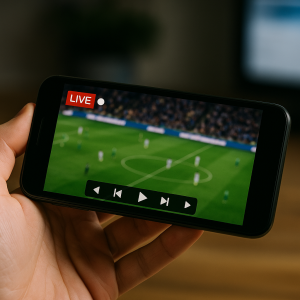
Football is the passion that moves the most people in the world, and the question "where will the game be broadcast?" has become more difficult precisely because there are more options. Broadcasting rights are now spread among free-to-air channels, pay-TV channels, streaming platforms, and even official club channels — and each competition sells by country and by season.
This guide is not just another list of miracle apps. It's a method: how to find out where your match will be broadcast, what's free and legal, and why the promise of watching everything without paying doesn't hold up, either technically or legally.
The rule that explains everything: broadcasting rights.
Clubs and competitions sell the rights to broadcast their games. Those who buy the rights pay a lot, and this revenue is one of the main sources of income for professional football—it finances clubs, youth academies, and ultimately, the spectacle you want to watch. That's why the rights holder protects the signal rigorously.
Three practical consequences arise from this. First: No free app can offer the major leagues, because there would be no way to pay for them. Second: The same game has different broadcasters in each country, so a recommendation from abroad may not work here. Third: When an app promises "everything live and free," it hasn't licensed anything—it's redistributing someone else's signal, which is illegal in Brazil under copyright law.
Advantages of watching football on your mobile phone
Real practicality
You can follow along from anywhere, with video when a broadcast is available in your region, or with commentary and score updates when there isn't.
Statistics that television doesn't show.
Heat map data, shots on goal, successful passes, and player ratings appear in real time on tracking apps, free of charge.
Notifications only about what matters.
Set up alerts only for your team and stop receiving goal notifications from championships you don't follow.
Choice of narration
There's nothing wrong with combining the image of one source with the radio narration of another. Many people prefer it that way.
Big screen whenever you want
Mirroring via Chromecast or AirPlay takes your phone screen to your TV with a single tap.
Legitimate free layer
Free-to-air TV, official YouTube channels, and radio cover a large part of the schedule at no cost.
Where to look, in the right order.
1. Official website of the competition
Almost all of them publish the transmission table by country. It's the primary and most reliable source — start here and you'll avoid all the rest of the search.
2. Social media and website of your club
The clubs announce each matchday where it will be broadcast. First-hand and up-to-date information.
3. Open television schedule
Before installing anything, check if the game is available on free-to-air television. Better image quality, zero data consumption, and no internet dependency.
4. Official YouTube channels for clubs, federations, and competitions.
Youth football matches, women's football, early-stage state championships, friendlies, and smaller tournaments are usually broadcast in their entirety and for free. Full highlights appear a few hours after the matches.
5. Live score apps
They are free and legal because they work with data, not images. They deliver the game play-by-play in text, with complete statistics.
6. Subscription services
This is where the major championships are held. Virtually all of them accept a monthly plan with no commitment—you can sign up for the month of the competition and cancel later, which usually costs less than maintaining several inactive services.
Interesting Extra Features
- 📊 Real-time statistics – possession, shots on goal, and individual performance during the match.
- 🔔 Team notification – only what you want to receive, and nothing more.
- 📡 Video quality control Reducing the resolution on 4G avoids surprises in your data plan.
- 🎙️ Radio on headphones with picture but no sound. – A classic solution for those who prefer a different narration.
- ⏪ Official highlights – published for free by the clubs' and competitions' channels.
Care and Common Mistakes
- ❌ Install APK from outside the store. – Illegal, unstable during gameplay, and a known malware vector, running on the same device as your bank.
- ❌ Using a VPN to bypass regional restrictions – It often violates the terms of use, can lead to account cancellation, and worsens the quality of the live stream.
- ❌ Watch in high definition on 4G – It consumes several gigabytes per hour.
- ❌ Forgetting the renewal date of the free trial Automatic billing is the default.
- ❌ Trusting app lists from another country – Rights vary from region to region.
Interesting Alternatives
- Internet radio Live narration, minimal data consumption, works on any phone and doesn't freeze.
- Bar, social club or friend's house It seems obvious, but it remains the cheapest way to watch the big game.
- Review programs and highlights – many are free and cover the entire round.
- Live local football Amateur and youth leagues are broadcast for free, and that's where the games closest to you are.
Why does your neighbor shout "goal!" before you do?
Every fan has experienced this: the whole building is celebrating, and on your screen, the defender is still taking the corner kick. It's not bad luck or a bad internet connection. Each path the match takes to reach you has its own delay, and they are quite different from each other.
From fastest to slowest, on average:
- Radio received over the air, Whether on a regular device or the built-in receiver in some cell phones, the signal is practically instantaneous. It goes from the broadcaster to your ear without any queue.
- Digital over-the-air television It arrives a few seconds after the play. The signal needs to be compressed to fit the broadcast and decompressed by your television, and this takes time.
- Subscription television It usually lags a bit behind the over-the-air signal because it goes through another distribution stage before reaching your decoder.
- Internet radio It accumulates a few seconds of reservoir power to prevent failure when the grid fluctuates.
- Video streaming It's the most delayed of them all, by a wide margin. A half-minute difference is common, and in some broadcasts it's even greater.
Add to these paths the scoreboard app, This system sends goal notifications the instant someone types the play into the system—often before the image even reaches anyone. That's why having your phone in your pocket spoils the surprise on the living room TV.
The path of the signal, from the stadium to your screen.
It's worth opening the black box, because understanding the trajectory explains why the delay can't possibly be zero.
It starts at stadium cameras, The images are sent to a central control room where someone chooses, live, which one will be broadcast. This selection process takes a moment. The chosen signal is then... tablet Raw video is too large to travel—and is sent to the broadcaster via fiber or satellite. Compression is inherently time-consuming: the equipment needs to look at a handful of frames before deciding how to reduce their size.
At the broadcast station, the graphics, replay, and narration are added, and the entire package is prepared for distribution again. By this point, broadcast television has already used up its few seconds, and the signal continues to the antennas.
When the destination is the internet, that's when things get really slow. The video is... cut into small pieces Each segment lasts a few seconds, and these segments are spread across servers worldwide to support millions of simultaneous viewers. Your player only starts displaying after it has a few segments ready—because if it displayed the first one immediately, any network fluctuation would freeze the image.
That's where the dilemma lies, one that no platform solves for free: Less delay means less reservation against lockdown.. There are low-latency modes that significantly reduce the difference, but they require a stable connection and are more prone to lag. Each service chooses where to fall on this balance—which is why two streams of the same match can be ten seconds apart.
How to synchronize radio narration with the image.
The classic combination — television image, narration from your favorite radio station — only works well if you resolve the mismatch. There is a way:
- Find out who's in the lead. Wait for a memorable play and see what happens first. The narration almost always comes before the image.
- If the radio is ahead, Delay the image: pause the transmission for a few seconds and then resume playback. On services with live timing control, this resolves the issue on the first try.
- If the image is ahead, Or, more rarely, try switching the audio source: one radio app might be slower than another, and over-the-air reception is the fastest of all.
- Adjust during the break, not in the middle of the play. You'll need two or three attempts, and it's frustrating to miss a goal while testing the ball.
- Leave the image without sound. Listening to two out-of-sync narrations is worse than any delay.
- If your cell phone has a built-in radio receiver, Use it with wired headphones: besides being the audio that arrives first, it doesn't consume any data.
A note for those watching with family: when everyone is at a different fountain, someone always reacts first. Using the same fountain for everyone in the room avoids premature celebrations.
Goal notification: how to avoid being given away by your own phone
There's no point in syncing everything if your phone announces the goal before you see it. It's worth making an adjustment five minutes before the match:
- Turn off notifications for the scoreboard app. On the days you'll be watching the game, leave them on only when you can't watch it.
- Mute message groups From the crowd during the match. It's the number one source of spoilers.
- Use focus mode or do not disturb mode., which allows you to schedule by time and grant access only to the people you want.
- Disable notification previews on the lock screen. So, even if something comes in, you don't accidentally read the scoreboard.
- Be careful with the connected watch. It often vibrates even when the phone is on silent.
- If you are watching with a deliberate delay, Stay away from social media until the final whistle. No setting protects against the timeline.
Questions about delay and synchronization
Is it possible to eliminate streaming lag?
Eliminate latency entirely, no. You can reduce it by choosing low-latency mode when the service offers it, using a stable wired or 5 GHz connection, and closing anything that is consuming network bandwidth in parallel. The minimum delay is a consequence of how the video is delivered.
Why do two devices in the house show the game at different times?
Because each device has its own video repository and may have started playing at different times. Restarting playback on both at the same time approximates the current playback, but never equals it.
Is the delay the same in all countries?
No. Each broadcaster and each platform sets up the transmission chain in its own way, and the signal path changes depending on the distance to the stadium. That's why the international broadcast of the same game can be very different from the local one.
Is internet radio as fast as traditional radio?
No. The online version adds a few seconds to prevent errors. The over-the-air signal remains the fastest way to follow a game.
Is it worth watching late to get better quality?
For those watching alone and without a cell phone nearby, yes: a little more buffering means less buffering. For those in a group or near noisy neighbors, the lag ruins the experience more than the quality compensates.
Read also
- Watch Football on Your Mobile: The Official App for Each Country and Championship
- Follow Football for Free: 5 Score and Statistics Apps
- Live Football Apps: What They Promise and the Risk of Piracy
- Watch Movies on Your Phone for Free: 5 Apps Without a Subscription
- Free and Legal TV on Your Cell Phone: 10 Apps with Live Channels
Common questions
No. Broadcast rights are exclusive and expensive. A free service cannot license them — anyone promising that is simply redistributing someone else's signal.
Free-to-air TV games, matches broadcast on official club and competition channels, smaller tournaments, women's football and youth categories — as well as official highlights.
Start by checking the official competition website, which publishes the broadcast schedule by country, and check the club's social media. It's faster and more reliable than any list of apps.
For high definition, yes — a few megabits per second, stably. For radio and live scores, practically any connection will do.
To protect browsing on public networks, yes. To bypass regional transmission blocking, no: it violates terms of use and degrades the quality of the live signal.
Conclusion
The right question isn't "which app shows everything for free," but rather "where is this game being shown here?" With the official competition website, the broadcast TV schedule, and a good live score app, you can figure out most of the schedule without spending a penny—and with better information than many live streams.
👉 Final tip: When the game is really behind a subscription, sign up for the month and cancel later. It costs less, it's legal, and it doesn't put your phone at risk. Share this guide with your fan group before the next round.