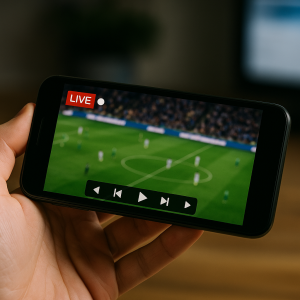
Free streaming exists and is legal — but it works in a specific way that almost no article explains. Platforms that offer their catalog without charging a monthly fee sustain themselves through... advertisingThey license titles from studios and sell commercial breaks. Advertising isn't a tolerated flaw; it's the revenue that pays for the licensing. You're trading money for attention.
Knowing this resolves the two most common frustrations of those who install these services. The first is searching for a movie release and not finding it: it's tied to exclusive, expensively sold slots. The second is hoping there are no commercials: if there weren't, the service wouldn't have the money to pay for the rights.
Below are seven free and legal platforms, what each one does best, and what none of them offer.
Understanding Streaming
What is Streaming
Streaming is the transmission of video or audio over the internet without the need to download the entire file beforehand. The server sends small packets of data, and the device plays them as it receives them, maintaining a small advance batch—the famous [unclear/unclear - possibly "software"]. buffer. That's why the video starts almost instantly and why it freezes when the connection fluctuates: it's out of stock.
Almost all services use adaptive quality: the player measures the available speed and automatically changes the resolution, preferring to continue playing at a lower quality rather than stopping. If your internet is limited, you can force a lower resolution in the settings and save a lot of mobile data.
Why does the catalog change all the time?
Each available title is a contract: the service has purchased the right to show it in that country for a specific period. When the contract expires and is not renewed, the film is removed—even if you had saved it to watch later. This is also why the Brazilian catalog is different from the Portuguese or American catalogs: rights are negotiated region by region.
Understanding this mechanism has a practical effect: when you find something you want to watch on a free service, watch it. The favorites list is useful, but it doesn't guarantee a subscription.
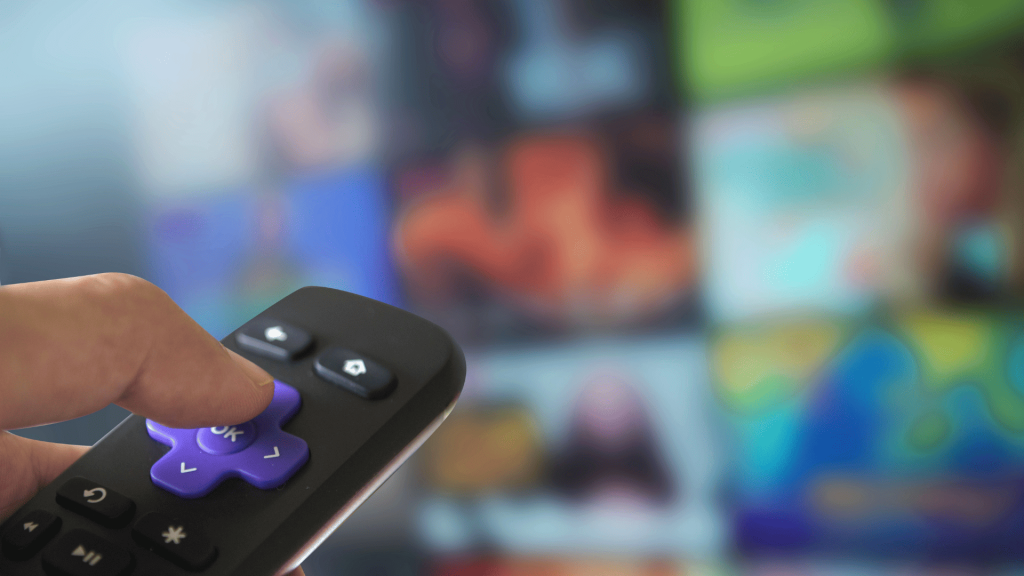
7 Free Streaming Platforms
All the options below are legal, licensed, and funded by advertising. Availability and catalog vary by country — it's worth checking your local app store.
- Pluto TVIt works like a television, with dozens of themed channels running non-stop, plus an on-demand catalog. It doesn't require registration, which is rare. Ideal for those who don't want to choose, just want something playing.
- VIX: It features a strong emphasis on Latin American productions, with plenty of content in Portuguese and Spanish, both dubbed and subtitled. This is usually the most convenient option for those who don't like subtitles.
- TubiA large, well-organized catalog by category, featuring partnerships with renowned studios. It works without an account, but creating one will save you where you left off.
- Libreflix: a Brazilian collection of independent productions, documentaries, and social and cultural content, much of it made available by the filmmakers themselves. It is the most outside the commercial circuit on the list.
- PlexIt has a free layer of movies and channels and, in addition, organizes its own library of legally acquired videos. The most versatile and the least intuitive.
- Rakuten TV (free section)Part of the catalog is open with advertisements, featuring a significant amount of European production. The rest is for rental or purchase—don't confuse the two areas.
- Viki: specializing in Asian dramas and films, with subtitles created by a global community of translators. The free version contains ads; the paid version removes ads and unlocks part of the catalog.
It's worth adding two free sources that almost nobody remembers: the official distributor channels on YouTube, which publish full movies with advertisements, and the digital over-the-air television, which continues to stream movies with good picture quality without using a single byte of your data plan.
What no free platform delivers
- Recent movie release. Exclusive window, sold to those who pay a subscription.
- The series of the moment. It's the main selling point of paid services.
- No announcement. If there's no monthly fee, the sales pitch is the revenue stream. Be wary of anyone who promises both.
- Download to watch offline. Rare in free-to-play versions, because advertising needs to be served during playback.
- Permanent catalog. Securities come in and go out as contracts expire.
Beware of "free streaming" that isn't legal streaming.
There is a parallel category of applications distributed via APK files, outside of official app stores, that promises a complete catalog, without ads and without payment. The rule for identifying them is straightforward: If the catalog includes what paid services charge to display, then nobody licensed anything.. Distributing copyrighted work without authorization is illegal in Brazil, according to the Copyright Law.
The practical risk is greater than the legal risk for the average user. These apps don't undergo any security review, often request permissions incompatible with a video player, and are a known vector for malware and ad fraud. And they disappear overnight when they're taken down, taking with them anything you've paid for.
On your cell phone, computer, or television: what changes on each screen?
The same service behaves differently on each device, and this is often mistaken for an internet problem. It's worth understanding the differences before blaming the connection.
On the cell phone, The app is in charge: it chooses the resolution according to the network, respects data saving mode, and usually offers the most complete features, such as resuming where you left off and sending the video to the TV. On the other hand, the small screen makes the difference between high definition and ultra definition practically invisible — and the data consumption is not.
On the computer, through the browser., There is a limitation that surprises many people: due to content protection requirements imposed by studios, some services deliver a lower maximum resolution to the browser than to the app. If the movie looks worse on a laptop than on a mobile phone, that's the problem, not your bandwidth. On the other hand, the web version doesn't take up space or ask for any permissions.
On connected television, The app is a simplified version, designed for remote control: fewer filters, slower search, and, on older models, freezing due to lack of memory. The advantage is the highest quality video available and decent sound output.
A difference that almost no one notices: The catalog may vary between platforms of the same service.. Some titles appear in the TV app and not in the browser, or vice versa, because the licensing agreement sometimes specifies on which type of device the work can be displayed.
How to get your phone movie onto your TV
There are three paths, and they are not equivalent. Choosing the right one resolves half of the large-screen freezing complaints.
- Send (the transmit button). When you tap the cast icon and select the TV, your phone isn't sending the image: it's only sending the video address, and the television is responsible for downloading and playing it. That's why you can exit the app, reply to messages, or even lock your phone without interrupting the movie—and that's why the quality is better. It's always the best option when it exists.
- Mirror your screen. Here, the phone captures everything that appears on the screen and transmits it via Wi-Fi, frame by frame. It consumes a lot of battery, heats up the device, is sensitive to any network instability, and, on several streaming services, displays a black screen due to content protection. It's suitable for photos, presentations, and websites—it's not the best way to record videos.
- Cable. A USB-C to HDMI adapter solves the problem without relying on a network connection. It's the most stable alternative at home with poor Wi-Fi, and the one that few people remember exists. Not all cell phones have video output via USB, so check before buying the adapter.
And there's a fourth possibility that completely eliminates the need for a cell phone: installing the service's app directly on the television, or on a streaming device connected via HDMI. If the TV is old and its app freezes, this little device usually costs less than two months of subscription and restores smooth operation to the entire house.
From where the video comes from to your screen.
The video has four segments, and the freezing occurs in one of them. Knowing which one saves a lot of wasted attempts.
The first excerpt is the source server, where the master file is kept. No one watches from there. The second is the content delivery networkCopies of the same video are spread across servers in various countries, including within Brazil, so that the data travels the shortest possible distance. This network is what makes a movie start in two seconds.
The third section is the your operator, which carries the content from the traffic exchange point to your home. And the fourth is the home networkRouter, distance, walls, number of connected devices. In the vast majority of cases, the bottleneck lies in this last part, the only one over which you have direct control.
One detail that explains the prime time: between the beginning and end of the night, everyone is watching at the same time, and the competition happens mainly on the local network and the operator's access. If the video always freezes at the same time and never in the early morning, the problem is not the streaming service — it's congestion.
Read also
- Watch Live TV on Your Cell Phone: 6 Free and Subscription-Based Apps
- Free Movies and TV Shows: 5 Legal Apps Supported by Ads
- Free and Legal TV on Your Cell Phone: 10 Apps with Live Channels
- Watch Movies on Your Phone for Free: 5 Apps Without a Subscription
- Free Movies and TV Shows: 8 Licensed Apps and Their Catalogues
Frequently asked questions about free streaming
Do I need to create an account to use the free platforms?
In most cases, no. Several people open it and start playing. The account is used to save favorites, sync between devices, and continue where you left off—it's a convenience, not a requirement.
Why does the video start out blurry and then improve after a few seconds?
Because the player starts at the lowest quality to avoid making you wait and increases it as it measures the actual connection speed. This is normal behavior and a sign that adaptive quality is working.
Does watching on TV consume more data than watching on a mobile phone?
It consumes more data because the larger screen has a higher resolution. The same hour of movie can cost three times as much data on a television compared to a mobile phone at medium quality.
Does free streaming work with radio internet or satellite internet?
It works, with caveats. Connections with high latency take longer to start the video and suffer in live streaming. For on-demand movies, setting a lower resolution usually solves the problem.
Can these platforms be used outside of Brazil?
Within the limits of the license. The catalog varies from country to country, and some services simply don't operate in certain territories. It's not arbitrary blocking: it's the exhibition contract.
Conclusion
The free streaming tier has matured significantly and now adequately covers those who want classic films, studio catalogs, documentaries, independent productions, and themed channels running all day. Install two or three of these platforms: the catalogs hardly overlap and, combined, provide many nights of entertainment without any monthly fees.
What's asked in return is to accept the commercial break — and that's fair, because it's what pays for the broadcasting rights. Anyone promising the same catalog without ads and without cost isn't being generous: they're distributing what isn't theirs, with your cell phone paying the price for security and privacy.