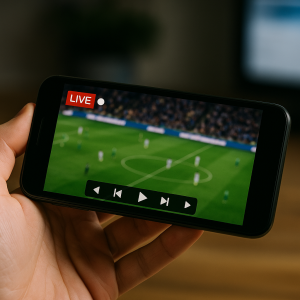
Asian cinema has conquered the world with narratives unlike any other: the Korean thriller that becomes social commentary, the Japanese drama built on silence, the Chinese wuxia, the Thai horror. After "Parasite" and series that exploded on streaming platforms, searching for this catalog has become a habit for many people here.
But the search often runs into a promise that hinders more than it helps: the promise of to go down These movies are being downloaded from any app. It's worth debunking this idea right away. An app that downloads movies from "specialized sources" is copying copyrighted work without authorization—which is illegal in Brazil under the Copyright Law—and, since it's outside official app stores, it comes without any security checks. It's not a shortcut: it's a risk you take on the same phone where your banking app is installed.
The good news is that there is a legal way, and it's better than it seems. This guide shows you where Asian cinema is legitimately available, how offline downloads work when they're official, and how to choose decent subtitles without resorting to dubious websites.
Advantages of watching through the official channel
Subtitles accompanying the film
In licensed services, the subtitles are synchronized and reviewed. Downloading individual subtitles from third parties is precisely where synchronization problems arise that ruin the experience.
Stable image and sound quality.
The service adapts the resolution to your connection. Files downloaded from unknown sources often come recompressed, with out-of-sync audio and sometimes a watermark.
An official offline version exists — on paid services.
Several subscription services allow you to download titles within the app itself to watch offline for a limited time. It's a legal download, and the right choice for those who want to watch on a plane or subway.
True curation
Platforms specializing in Asian content organize by country, director, and genre, which greatly helps in discovering works outside the commercial circuit.
No malware.
The official store app is undergoing review. The security gain is the least glamorous but most important benefit on the list.
The catalog will still exist tomorrow.
Pirated services disappear offline when they are taken down, without warning. Licensed platforms do not.
Where is Asian cinema legal?
1. Platforms specializing in Asian content
There are services dedicated to dramas and films from Korea, Japan, China, and Thailand, with subtitles in various languages—some created by communities of volunteer translators organized by the platform itself. They usually have a free tier with ads and a paid tier without ads, with a larger catalog and offline download.
2. Free services supported by advertising
Platforms like Tubi, Pluto TV, and Plex have Asian film sections within their general catalog. They are free, legal, and funded by advertising—the commercials pay for the licensing. The catalog varies by country and changes when contracts expire.
3. General subscription services
The major paid platforms have invested heavily in Korean and Japanese productions in recent years, and it is on these platforms that you can find the latest titles and original productions. This is where official offline downloads work best.
4. Official YouTube channels
Asian distributors and broadcasters publish full movies and subtitled episodes for free, with ads, on official channels. Just confirm that it's the official channel—pirated copies also appear there until they are removed.
5. Online festivals and exhibitions
Asian film festivals and Brazilian film showcases offer online programming for limited periods, often for free. It's worth checking the calendar: that's where films that don't appear in any commercial catalog are shown.
6. Public and university libraries
Some institutions offer access to movie streaming platforms with library cards. It's free, legal, and almost nobody uses it.
How does the official download work?
When a subscription service offers a download function, the file becomes available. within the application, The file is encrypted and expires after a period defined in the licensing agreement—generally a few weeks, or shortly after you start watching. You can't copy this file to another device, and that's precisely why the studio authorizes it.
This is different from what a generic download application promises, which generates a free file in your storage. This difference is the boundary between legal offline downloads and unauthorized copies — and it's useful to know it to understand what you're installing.
Choosing subtitles without the headache
- Prefer the service's embedded subtitles. It was synchronized to that exact version of the film.
- Adjust the size and color in the player settings. A large part of the complaint about "bad subtitles" is about readability, not translation.
- If the translation seems strange, Try searching for the same title on another platform: different subtitles come from different works.
- Activate the original audio. When dubbing is involved: in Asian cinema, intonation and rhythm are part of the acting.
- Use headphones In films with sophisticated sound mixing — many Japanese and Korean productions work with ambient sound in great detail.
Care and Common Mistakes
- Install APKs from outside the store. This is the source of most problems: lack of security review, with abusive permissions.
- Trusting an app that promises "all the movies". If it includes what the paid users charge, it didn't license anything.
- Download subtitles from a website with many redirects. The subtitle file can also be a vector of attack against outdated players.
- Sign up for the service just to download everything and then cancel. Downloads expire with the subscription — it's the model, not a flaw.
- Ignore data usage. Always download over Wi-Fi; a high-definition movie consumes several gigabytes.
- Failing to check regional availability. A title may exist in another country's catalog but not in ours, due to copyright issues.
Why do so many award-winning Asian films not appear in any catalog?
This is the question that remains after searching three services and not finding the title. The answer isn't piracy hidden somewhere: it's distribution economics, and it works like this.
For a foreign film to legally reach Brazil, someone needs to buy the rights to screen it. in this territory, For a limited time, that party—a distributor or the platform itself—also assumes the cost of preparing the work for the local audience: revised subtitles, sometimes dubbing, promotional material, and age rating. For a blockbuster, the numbers add up quickly. For an independent Thai drama from twenty years ago, it often never does.
Add to this a detail that directly affects older Asian cinema: the international rights to works from the 1960s to the 1990s are often fragmented among studios, heirs, and sales agents from various countries. It is not uncommon for no one to even be able to reliably identify who can authorize a screening. Films in this situation disappear from the legal circuit for bureaucratic reasons, not due to censorship or lack of interest.
What to do when the title you want is in limbo? There are four legitimate paths, in order of ease:
- Rent or purchase a digital item on a one-off basis. Many works that aren't included in any subscription service are available to rent for a small fee, for 48 hours. It's great, it's cheap, and almost nobody remembers to look for them.
- Exhibitions and festivals. Asian film retrospectives are precisely where these works reappear, often with online screenings for a few days.
- Physical media. Disc editions from specialized distributors still exist and usually include better subtitles and extra material.
- Film clubs, cultural centers and universities. Licensed public screenings take place throughout the year and are rarely publicized outside the circuit.
And patience is key: titles that disappeared will return. Since licenses have expiration dates, the same film reappears on another platform months later with some frequency.
What to download before leaving home
Long trips, flights, subway rides without signal, and intercity buses are exactly the scenarios in which an official download justifies the subscription. However, it requires some planning, because the protected file has its own rules.
- Download via Wi-Fi the day before. A high-definition movie takes up several gigabytes; on mobile data, this reduces the franchise and takes longer.
- Check the available space beforehand. The app usually warns you when you're running low on space, but only after you've started using it. Leave a few gigabytes of free space.
- Choose the download quality. Almost every service lets you choose between standard and high resolution. For watching on a mobile phone screen, standard resolution is sufficient and offers much more storage.
- Check the expiration date. The file expires: generally a few weeks after downloading, or much less after you press play for the first time.
- Open the app with internet access before traveling. Many services periodically renew their license; if the app is offline for weeks, the title may crash just when you need it.
- Download one more than you intend to see. It's the difference between a smooth trip and an error screen mid-flight.
One important note to avoid frustration: a downloaded title is not a purchased title. If the subscription ends, the download will stop working as well — this is not a defect, it's the condition under which the studio authorizes the temporary copy.
Screen, headphones, and environment: how movies perform better on mobile phones.
Asian cinema often employs dark photography, long takes, and detailed ambient sound. Watching it haphazardly wastes half the film, and some minor adjustments can significantly alter the outcome.
Fixed brightness, not automatic. The automatic adjustment keeps going up and down according to the room's light and ruins the dark scenes, which are a hallmark of much of Asian horror and Korean noir drama. Set the brightness to a comfortable level before you begin.
Reduce the surrounding light. This is worth more than any app setting. In a bright room, the black on the screen turns gray and you lose shadow detail.
Use headphones. The phone's speaker cuts the bass and flattens the mix. If the headphones are wireless, be aware that there is a slight delay between image and sound; video applications compensate for this delay automatically, so there's no problem in movies — the discomfort only appears in live streaming and gaming.
Don't expect 4K on your phone. On a small screen, the difference between high definition and ultra-high definition is practically invisible at a normal viewing distance, and data consumption triples. Save 4K for when you're mirroring on your television.
Enable player touch lock, When present, it prevents a bump on the screen from pausing the movie or skipping fifteen minutes of the story.
Quick questions for beginners
What is the difference between a dorama and a K-drama?
“"Dorama" comes from Japanese and in Brazil has become an umbrella term for Asian TV series in general. "K-drama" specifically refers to South Korean productions. Films and series follow different licensing paths, which explains why sometimes one is available and the other is not.
Is watching dubbed versions worse?
It's not worse, it's different. Dubbing helps those who have difficulty reading subtitles or want to do something else while watching. In productions that rely heavily on intonation and silence, the original audio preserves acting choices that dubbing needs to recreate.
Do I need fast internet to watch?
For medium quality, around 3 Mbps is usually sufficient; for stable high definition, about 5 Mbps. Below that, the player reduces the resolution automatically instead of stopping.
Can I watch it on my computer?
You can use it through your browser on most services. It's worth knowing that some services limit the maximum resolution in the browser due to content protection—if the image looks worse than on your phone, that's the problem, not your internet connection.
Read also
- Free Movies and TV Shows: 5 Legal Apps Supported by Ads
- Watch Movies on Your Phone for Free: 5 Apps Without a Subscription
- Free and Legal TV on Your Cell Phone: 10 Apps with Live Channels
- Watching Free TV on Your Cell Phone: The Legal and the Risky Options
- K-Drama on Mobile: Where to Watch for Free and What's Missing
Common questions
Legal downloads exist, but they occur within subscription-based service applications, where the file is protected and has an expiration date. Generic applications that download from "various sources" are copying copyrighted work.
It's available on free, ad-supported platforms, official YouTube channels, and online showcases. What doesn't exist is a complete catalog, ad-free and without payment.
Broadcast rights are negotiated on a country-by-country basis. The same service has different catalogs in each region, and this is contractual.
No. There is no security review outside of the store, and these apps are a known vector for malware and ad fraud.
Keep up with Asian film festivals and screenings, see what specialized platforms are offering by country, and check if your library offers access to any film streaming services.
Yes. The official apps support Chromecast, AirPlay, or have a version for connected TVs.
Conclusion
Asian cinema deserves to be seen properly: with the right subtitles, in the image approved by the director, and without a suspicious app running in the background on your phone. This is perfectly possible today — partly for free, with ads, and partly by subscription, with an official download to watch offline.
There's no such thing as the shortcut advertised out there. Apps that claim to download everything for free are distributing what doesn't belong to them and charging you for security and privacy. Install one or two legitimate free services, check out the online selections, and when you want a specific, recent title, subscribe for a month and cancel later. It's cheaper than the risk of a faulty installation.